

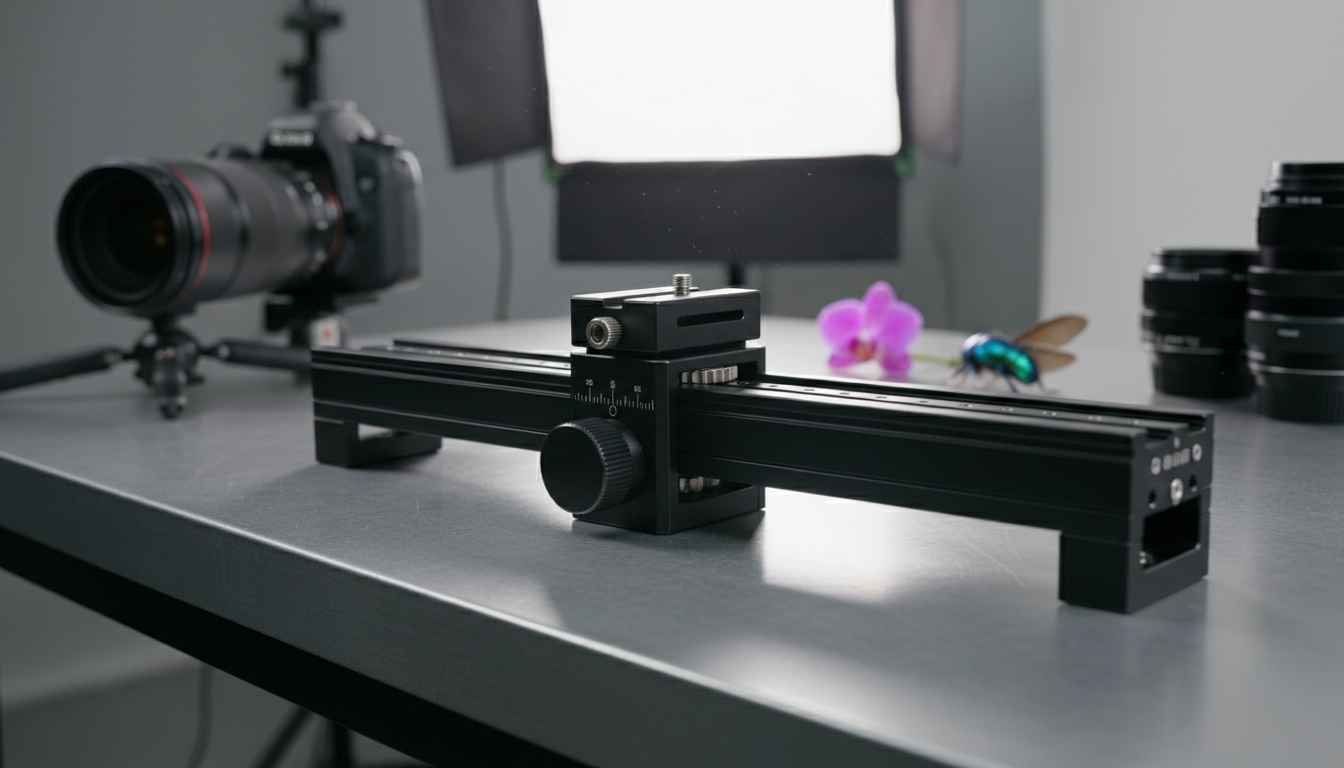




Remember the meticulousness of Walter White in Breaking Bad, carefully measuring every element to perfection? That level of precision is what macro photographers aspire to when capturing the finest details of a subject. Enter the focusing rail for macro photography – a tool designed to elevate control, sharpness, and composition in ways a standard tripod simply cannot match.
Macro photography is unforgiving. At high magnifications, even the slightest camera shift can throw your subject out of focus. A focusing rail provides incremental control over the camera’s position, allowing adjustments along the X, Y, and sometimes Z axes. This is especially critical when capturing subjects like insects, textures, or intricate mechanical components where millimeters matter. The rail acts as a precision stage, offering photographers a way to methodically compose shots with surgical accuracy.
From a compliance perspective, the use of focusing rails aligns with established standards in professional photography gear. ISO 12233, for instance, outlines methods for measuring resolution, which inherently supports the necessity of precise camera positioning. Professionals seeking verifiable image quality often adopt focusing rails to maintain adherence to these standards. For those exploring high-fidelity black and white macro photography, tools like those found at ILFORD PHOTO provide the reliability needed for consistent, repeatable results.
Reality Check: Expectation vs Reality
Expectation: A focusing rail instantly transforms any amateur into a precision macro photographer, delivering perfect focus across all shots. Reality: While focusing rails dramatically improve control, mastery still requires patience, understanding of depth of field, and familiarity with your subject. The rail is a facilitator, not a replacement for skill.
Expectation: Any rail will do. Reality: Build quality, load capacity, and smoothness vary greatly. Lightweight models might flex under heavier DSLRs, affecting sharpness. High-end rails offer micrometer adjustments with minimal vibration, essential for subjects that cannot be retaken.
Expectation: Time saved. Reality: Using a focusing rail involves more setup and planning. Each incremental adjustment takes time, but the payoff is unmatched precision and professional-grade results that justify the investment in both skill and patience.
Why a Focusing Rail Matters
Depth of field in macro photography is notoriously shallow. Even with apertures stopped down, portions of your subject may fall out of focus. Focusing rails allow for focus stacking, a technique where multiple images taken at slightly different distances are combined to produce a single frame with extended sharpness. This is standard practice in museum documentation, product photography, and scientific imaging, where every micron counts.
Additionally, a focusing rail ensures consistent framing and alignment, critical when documenting series or creating composite images. The precision it offers reduces post-processing time and enhances the integrity of the final image.
Potential Drawbacks
Despite the advantages, focusing rails have limitations. They increase setup complexity and can be cumbersome in field photography. Transporting them for outdoor shoots can be challenging due to size and weight. For casual photographers, this may outweigh the benefits, as simpler tripod setups may suffice for less critical work.
Budget is another consideration. High-precision rails are a significant investment, which may not be justifiable for hobbyists. Users must weigh the cost against the desired image quality and workflow efficiency.
Practical Implementation Tips
When selecting a focusing rail, consider the load capacity, travel range, and adjustment increments. Aluminum rails are lightweight, but steel models offer better stability for heavier setups. Test the rail for smooth movement and minimal backlash before committing to long sessions. Pair it with a sturdy tripod to minimize vibration, and remember that incremental adjustments matter more than speed.
For macro photographers embracing black and white film or high-detail digital captures, integrating a focusing rail into your workflow can dramatically enhance image fidelity. By combining precision movement with proper lighting and lens selection, the rail transforms the painstaking process of macro photography into a controllable, repeatable, and compliant practice that meets professional standards.
Ultimately, the focusing rail is a tool for those who refuse to compromise on detail. It bridges the gap between expectation and reality, ensuring that every shot is not only in focus but crafted with the meticulous care that macro photography demands.

